Did you know? No. 17
On 27th April 1780 , Reverend William Dobree offered two vergees of land at the bottom of his garden for a cemetery (Odeon Site), in what is now Upland Road.
The 18th century had brought an ever increasing number of people into St Peter Port from the Country, England and Europe.
With a garrison at Fort George, a Naval presence at the harbour, as well as St Peter Port being a busy trading port, the Sisters and the Brothers Cemeteries were becoming full and so it was agreed an additional cemetery was required.
Back in 1736 the parish had wanted to cut costs, by ceasing to pay the parish grave diggers for digging parish graves and the sexton for ringing the bell at paupers funerals.
Once the Town Hospital was in operation in 1743, all burials were conducted from there.
Constables would apply to the Hospital for the service.
Inmates would collect the deceased, transfer to cheap coffins made in the Hospital workshops and carry them to the various town cemeteries.
Following a brief graveside service, internment took place in an unmarked paupers vault.
In the eighteenth century the paupers were buried in the Sisters and Brothers Cemeteries; in the nineteenth century the Strangers and Candie Cemeteries and finally from 1932, at the Foulon Cemetery.
The Strangers Cemetery was originally to be for the burial of people who were not domiciled in the town and the parish or for soldiers of the garrison.
Rev. Dobree agreed to the Stangers Cemetery being built, with the understanding that a 7ft high bank was built, between the cemetery and the rest of his land.
The land was purchased, but for safety the proposed bank was too high, and so it was decided to build a dry stone wall.
Later the same year, Rev. Dobree offered to build a wall which was 8 ft tall and 22inches thick. It was agreed as it would benefit the cemetery, at no cost to the parish.
The wall cost £225.6s tournois or £16.1s.10d sterling.
Rev. Dobree was paid for walls and land in 1783 and in 1784 a further £66 tournois for gate posts.
The part of the cemetery not walled, had a fence around it, made by the inmates of the Town Hospital in 1788.
Seventy five planks of wood 6 to 7 ft long were provided by Richard Le Lievre and inmates were told to make a fence along the southern end.
The Hospital Directors also decided in 1792 that inmates would be buried at the Strangers Cemetery, rather than the Brothers Cemetery.
The earliest gravestone found commemorated a Peter Pilkington, who died on the 6th November 1782, aged 60.
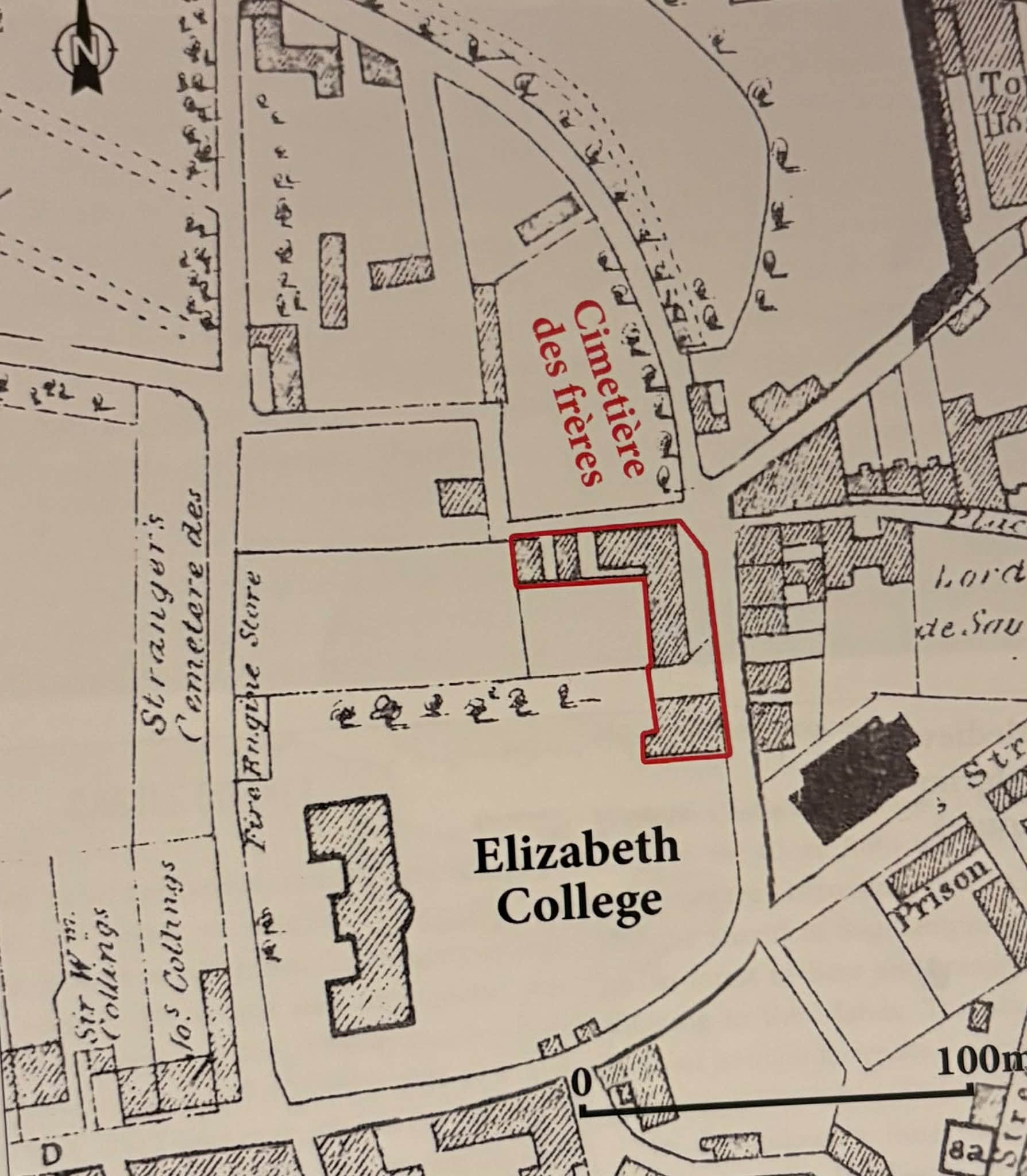
In 1807 a meeting was held to discuss a small muddy lane which led from the Grange, behind Elizabeth College to Rue des Freres.
It was decided to close the lane, add it to the cemetery and make a new road across the middle of the cemetery, called Upland Road.
In 1830 another meeting was held to discuss widening the road and to enclose the cemetery.
Discussed again in 1831, the Churchwardens were told to widen the road and put the barriers back. It was agreed to put a 5 ft wall.
By 1831 the cemetery was becoming full and the burials disturbed by widening Upland Road, would be moved to Candie Cemetery.
In 1832 Guernsey suffered a Cholera epidemic. Though there were vaults at Candie Cemetery especially for the victims, four people were buried in the Strangers Cemetery, Daniel & Prudence LeR, Ann N and Martha H.
In 1833 the States put up a building in the corner of the cemetery, at a cost of £200 to install two fire pumps, to protect both persons and property.
When Candie Cemetery was opened, parish officials thought paupers vaults would be added in the eastern corner of the cemetery, as at Strangers, but the trustees strongly objected and so a further five vaults were built between 1841 - 1853 at the Strangers cemetery, which held between 200 -250 paupers burials in each vault.
By 1857 there was no more room left and the Trustees of Candie Cemetery eventually agreed to build some paupers graves.
The cemetery was finally closed by Ordinance of the Royal Court on the 15th July 1882.
In 1928 the cemetery was passed from the Churchwardens to the Constables, it was decided to lay out a garden with trees, shrubs and pathways and the vaults should remain undisturbed and gradually filled in as time went by.
It was only in 1948 that parish burials were entrusted to a professional undertaker, and the workhouse connection which so many found distasteful was finally severed.
1988 the Royal Bank of Canada built new premises on the eastern side and in the course of making the forecourt, 2,650 bodies were exhumed. They were reburied at a special ceremony at La Foulon, attended by the Constables and Douzaine of St Peter Port, and representatives of the Bank.
In the early 1990s the Board of Directors of Elizabeth College built a new Sports Hall, the utilities were taken from the college grounds out to Upland Road and disturbed several burials. They had dug through a paupers vault. The remains were re-interred at St Johns Churchyard, Les Amballes.
The last memorial remaining at the Strangers Cemetery is for Sergeant Mac Donald of the 93rd Regiment, Sutherland Highlanders, who died in 1802 aged 41, having served for 24 years, it was said, he was beloved by his Fellow Soldiers and remembered for his stature at 6ft 10 and his great strength.
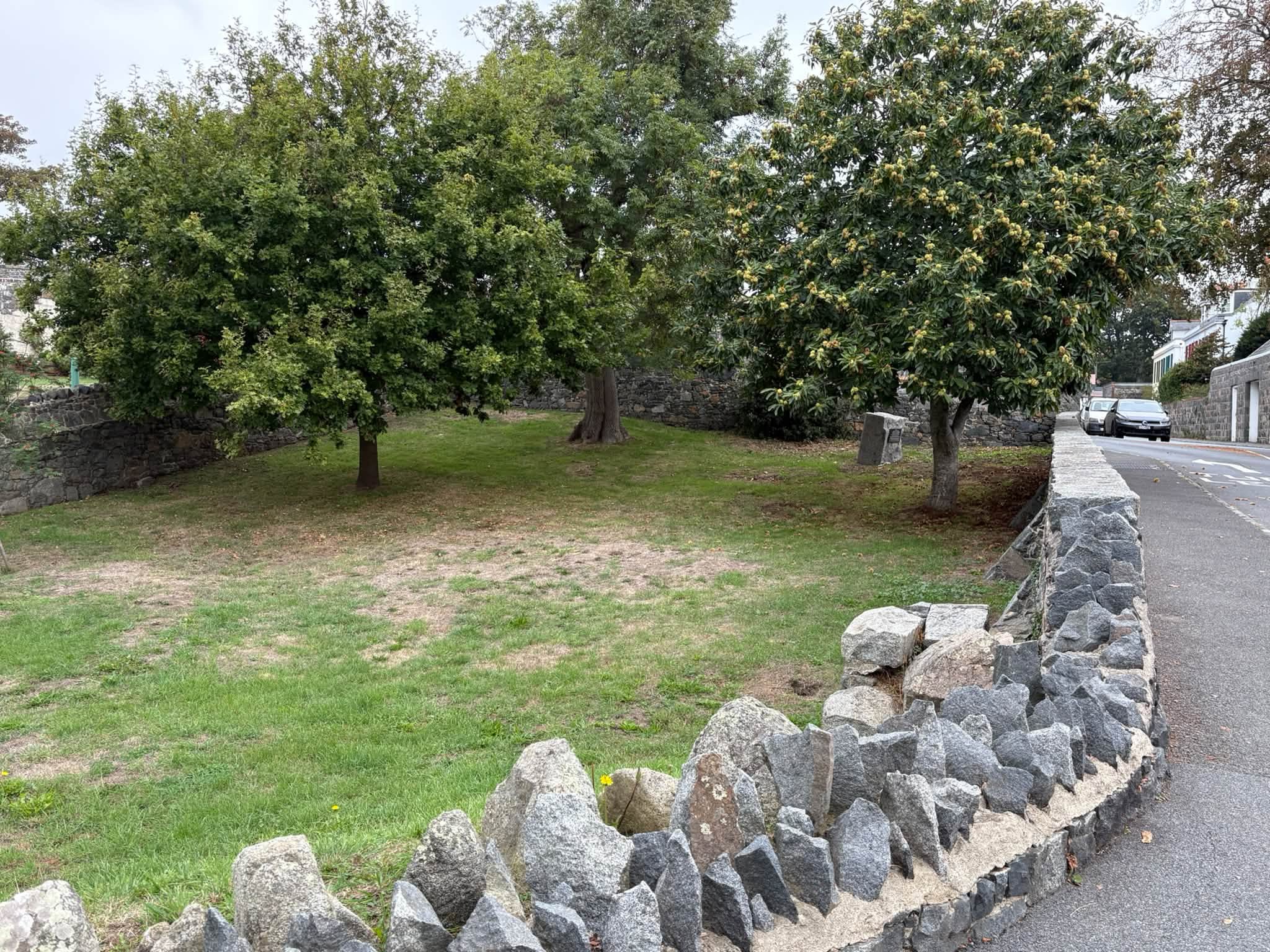
Those of a certain age may remember visiting the Odeon Cinema on a Saturday morning. Children would race from the cinema after the show, to find the very best conkers from the Horse Chestnut trees.
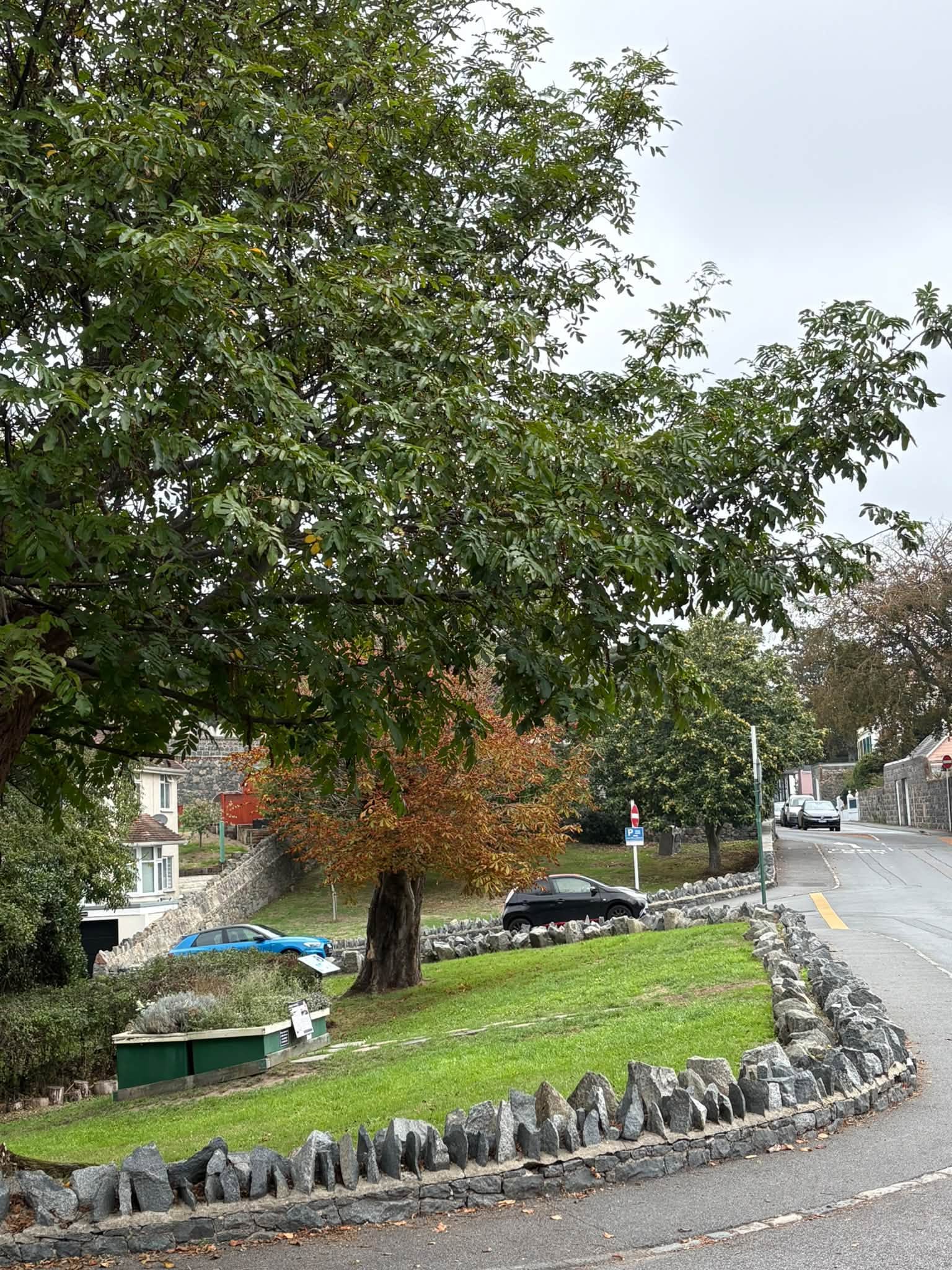
Horse Chestnut trees can still be found on the site today!
On visiting the site today , a display box of herbs maintained by the Parish Grounds Team can be found. The herbs are available to everyone, please feel free to pick a sprig or two when passing!
The site is still the responsibility of the Constables of St Peter Port and is maintained and cared for, by the Parish Grounds Team.
References - Gillian Lenfestey
References - Rose-Marie Crossan
References - Gregory Stevens Cox